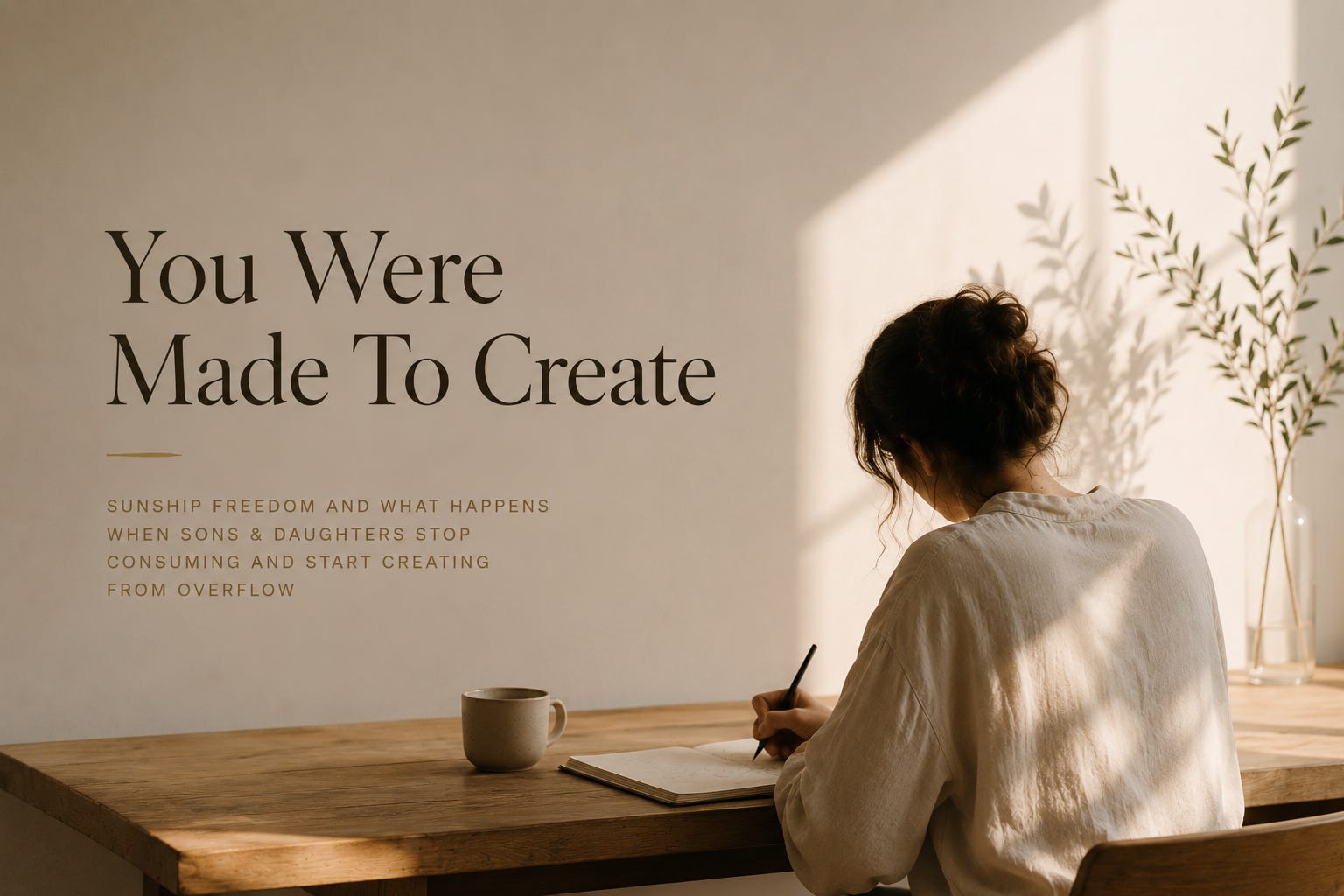
There is a question that has been sitting with me as a personal conviction that keeps pressing deeper into my own life.
What if we actually lived like sons and daughters of God — not just in how we pray, but in how we create?
The very first thing the Bible tells us about God is that He creates. Before we know His name, before we know His law, before we understand His love — we see His creativity. “In the beginning, God created the heavens and the earth” (Genesis 1:1). It is His first act where He reveals Himself leaving His divine fingerprint on everything that exists.
And then He makes man and woman in His image. Not in the image of an angry tyrant or in the image of a detached deity. In the image of a Creator. “So God created mankind in his own image, in the image of God he created them” (Genesis 1:27). Which means the instinct to make things — to build a structure or paint a beautiful picture, write original music, cook a family meal to design a logo, to imagine — is not a hobby or a luxury. It is a reflection of who God is, woven into the very fabric of who we are.
The Psalmist captured this when he wrote, “I praise you because I am fearfully and wonderfully made” (Psalm 139:14). You are not an accident or something that was mass produced on an assembly line. You are a handcrafted image-bearer of a creative God, and the creativity inside you is part of that design.
We were made to create. Not just to consume.
Here is a simple, honest question: how much time did you spend today consuming content? Be honest there’s no shade here.
Scrolling social media. Watching TV. Listening to podcasts. Flipping through short videos. Refreshing feeds. Taking in, taking in, taking in — an endless river of other people’s voices, other people’s stories, other people’s creativity pouring into us. And most of us do this for hours every single day.
Now I’m not here to guilt anyone about watching Netflix or enjoying Instagram. There is nothing inherently wrong with consuming good content. Rest is real. Entertainment has its place. But here is a thought I want to challenge you with:we have traded the posture of a creator for the posture of a consumer — and most of us don’t even realize it. We are image-bearers of a creative God, and we are spending our evenings watching other people live.
One of the most transformative things the Gospel gives us is not just forgiveness — it is identity. Through Christ, we are not merely servants pardoned from punishment. We are sons and daughters welcomed into the family of God. “See what great love the Father has lavished on us, that we should be called children of God! And that is what we are!” (1 John 3:1). Adopted. Beloved. Fully accepted.
And this should changes the entire posture of how we live — including how we create. Think about what drives most human creativity in the world. Approval. Recognition. Validation. We create to prove something — to ourselves, to our parents, to an audience, to the algorithm. We create out of strife. We grind hoping someone will finally tell us we are “enough” and that our work “matters”, that we matter.
But sonship breaks that cycle entirely. When you know you are loved by the Father — truly, deeply, unconditionally loved before you have done a single thing to earn it — the need to create for approval evaporates. You are not creating to become someone. You are creating because of who you already are. A son. A daughter. An heir of the MOST HIGH who spoke the cosmos into existence. As Paul writes, “The Spirit you received does not make you slaves, so that you live in fear again; rather, the Spirit you received brought about your adoption to sonship” (Romans 8:15).
That is not striving. That is overflow.
There is a profound difference between creating from obligation and creating from overflow. Obligation creates to prove itself. It is anxious, driven by the fear of falling short, desperate for applause. It asks, “Will this be good enough? Will people like it? Will it perform?” It is exhausting work because it is never finished — there is always another benchmark to meet, another audience to please. Another rung on the ladder of a life of performance.
Overflow creates from rest. It is grounded in love, not fear. When you are secure in the Father’s love — when you genuinely know that you are His and nothing you do or fail to do changes that — then creation becomes an act of joy rather than an act of survival. Paul put it this way: “Whatever you do, work at it with all your heart, as working for the Lord, not for human masters” (Colossians 3:23). That is the key shift. When God is your audience, the tyranny of other people’s opinions loses its grip.
This is the freedom that sonship unlocks. You don’t create to earn God’s blessing. You create, and then you surrender that creation to Him — and He blesses what is offered in faith.
In Matthew 25, Jesus tells the Parable of the Talents. A master entrusts his servants with resources before leaving on a journey — five talents to one, two to another, one to a third. When he returns, the servants who invested and multiplied what they were given are celebrated: “Well done, good and faithful servant! You have been faithful with a few things; I will put you in charge of many things” (Matthew 25:21). But the servant who buried his talent out of fear? His master’s response is sobering.
Here is what strikes me about this parable: it is not about money. It is about faithful use of whatever God has placed in your hands. Whether it’s your creativity — your ability to write, build, design, teach, cook, lead, make, imagine — is a talent. It was entrusted to you by the Master. And one day, He will ask what you did with it.
The question is not whether you are “talented enough”. The question is whether you are being a faithful steward of what you have already been given. Every hour spent passively consuming when you were created to actively make is, in a very real sense, a buried talent. Not because rest is wrong, but because a buried gift — hidden away out of fear, insecurity, or simple inertia — honors neither you nor the One who gave it.
God blesses what is surrendered to Him. A boy offers five loaves and two fish — small, ordinary, not nearly enough on their own. But placed in the hands of Jesus and offered freely, it becomes more than enough for thousands (John 6:9–11). This is a picture of how the Kingdom works when we create with open hands. He takes what we offer and multiplies it beyond what we could achieve alone.
So the practical question becomes: how do we actually begin to steward our creativity well? How do we break out of the consumption cycle and start creating from the overflow of sonship? Here are five steps rooted in Scripture that you can implement right now.
The master in the parable knew exactly what he had entrusted to each servant. Do you know what God has entrusted to you? Go to your phone’s Screen Time (iPhone) or Digital Wellbeing (Android) settings right now and look at your weekly average. See the actual number. How many hours per week are you consuming versus creating? Write it down. Then ask yourself honestly: if I stood before the Lord today, would I call myself a faithful steward of the time and gifts He has given me? Let that question be conviction, not condemnation — and let it be the first step toward change.
Scripture reminds us that “each of you should use whatever gift you have received to serve others, as faithful stewards of God’s grace in its various forms” (1 Peter 4:10). You don’t need to create in every medium — just one. Grab a piece of paper and finish this sentence: “The gift God has placed in me that I have not fully used is ____________.” It could be writing, teaching, building, designing, cooking, leading, making music, creating with your hands, mentoring, or something entirely your own. Write the first thing that comes to mind. That is probably the one. Start there.
Moses was instructed to “teach us to number our days, that we may gain a heart of wisdom” (Psalm 90:12). Time is the one resource you cannot get back. Open your calendar right now and block one hour each day this week — ideally in the morning, before the noise crowds in. Label it your “Creator Hour.” During that hour: phone face down, notifications off, no consuming. Only making. Treat it like a meeting with God, because in a very real sense, that is exactly what it is — an act of stewardship, an investment of the time He has given you back into the purposes He made you for.
The servant who buried his talent didn’t bury it because he lacked ability — he buried it because he was afraid (Matthew 25:25). Perfectionism is fear wearing a creative costume, and it is almost always rooted in a failure to rest in sonship. Here is your permission slip: your first attempt does not have to be good. It just has to exist. Write the ugly first draft. Record the shaky first video. Plant the first seeds. God does not need your masterpiece to start working through you — He just needs your obedience. Do the first five minutes of your one thing today. Not tomorrow. Today.
At the end of each creative session, before you close your notebook or shut your laptop, take sixty seconds and pray over what you made. It doesn’t have to be eloquent. Something like: “Father, this is Yours. I don’t know what You want to do with it, but I trust You. Bless it. Use it. Help me to keep creating from love, not from fear.” Then let it go. Don’t obsess over the outcome. Don’t refresh the stats. “Commit to the Lord whatever you do, and he will establish your plans” (Proverbs 16:3). Leave the results in His hands — that is where the blessing lives, and it is where a faithful steward rests.
These five steps will not make you famous. They will not guarantee virality, income, or applause. But they will do something far more valuable: they will make you a faithful steward of what God placed inside you. And over time, a life full of things you have made — created from the overflow of His love, surrendered to Him with open hands — is one of the most powerful testimonies of sonship there is.
You are not a consumer with a screen addiction. You are a son. You are a daughter. You are a co-creator made in the image of the God who spoke light into darkness, who formed beauty from nothing, and who looked at what He made and called it very good.
One day He will look at you and ask what you did with what He gave you. Let your answer be: I used it. I offered it. I held it out with open hands and trusted You with the rest.
That is not the prayer of a slave. That is the prayer of a son.
You were made to create. Go and make something.