I was reading through the first few chapters of Proverbs the other day when a word stopped me.
It appears again and again in those opening chapters, right alongside wisdom, knowledge, and understanding, as if it belongs in the same company. This was fascinating to me and as I dug deeper into studying the meaning of the word and context in which it was written, I realized that I had spent very little time ever considering it.
“Discretion will preserve you; understanding will keep you.” — Proverbs 2:11
Preserve you. Keep you. That’s speaking of protection. Discretion, it turns out, isn’t a minor virtue. It’s a guardrail. The more I re-read that passage, the more I understood why I’d needed it in seasons where I didn’t have it.
My mind went to the story of Joseph.
Here was a young man with a genuine God dream, receiving a real word from God about his future. There was nothing false about what he saw. The dream would eventually come to pass exactly as God showed him. However, Joseph took that dream, still fresh and unprocessed, and laid it out in front of his brothers.
“Listen to this dream I had…” — and he told them how their sheaves would bow to his. (Genesis 37:6-7)
The dream was true. The timing of sharing it was not considered and neither was the audience.
Here is a perspective that maybe needs Joseph was his father’s favourite (Genesis 37:3), and that position likely shielded him from the same feedback, correction, and responsibility his brothers carried. He wasn’t out in the fields absorbing the kind of formation that comes from being challenged, tested, and told no. He was given a special coat instead of the ordinary friction that shapes discernment.
Sheltering a child from feedback and correction doesn’t prepare them for the world, it often just delays the very lessons they’ll need. I wonder if some of Joseph’s lack of discretion wasn’t just youthful excitement, but the natural result of never having been given the chance to develop it. Discretion is often formed in the friction of correction. If a son is protected from all of that, he may reach adulthood carrying real revelation without the maturity yet to steward it well.
I’ve wondered how differently things might have unfolded had Joseph held that dream a little closer, exercising better discernment about who was safe to carry it with him. His brothers already resented him, in part because of the very favouritism that had shaped him. They were not people he could process something that sacred with. Some things are true and still not meant to be spoken yet. And some things are true and still not meant to be spoken to certain people, not because the people are enemies in some dramatic sense, but because they simply aren’t safe places for something tender to land.
Notice, too, that this isn’t only a warning to the ones who overshare. It’s also a word to those raising up sons and daughters. Correction and responsibility are not the absence of love, they are part of how discretion gets formed in a person before they ever have something significant to carry.
That’s where this became personal for me.
I know what it is to be excited about something God is doing. To receive a revelation, or sit under a teaching that unlocks something in you, and feel that surge of I have to tell someone. And honestly, the impulse to share hasn’t always come from a pure place.
Sometimes it came from insecurity.
There’s a version of oversharing that looks like enthusiasm but is actually a bid for acceptance. We’re carrying something new, and underneath the excitement is a more subtle question: will this make me belong? will this earn me a place in the room? So we put the revelation on the table prematurely because we needed the affirmation not because the moment called for it.
I’ve done that. I’ve taken things that were still forming in me, whether teachings, insights, things I felt God was showing me, and shared them too soon, and sometimes with the wrong people. Some of them, I’ve come to believe, were never meant to be shared at all, or at least not with those particular people, in that particular room.
It has cost me, brought strain into relationships and has even left me misunderstood by people I was close to. The very thing I hoped would draw me nearer to people ended up creating distance.
Here’s what I’ve had to face: the impulse to overshare is, at its root, an orphan impulse.
An orphan has to prove he belongs. He has to display what he’s carrying to secure his place and with anyone who will listen. A son doesn’t need to do that. A son already knows he belongs, so he can hold something quietly, discern who it’s safe to process with, and trust that what God is forming in secret doesn’t need an audience to be real.
This is where discretion and discernment meet.
Discretion asks, is this the right time? Discernment asks, is this the right person?
Both are forms of wisdom, and both require maturity to develop. Not everyone who asks what’s on your heart is a safe place for it. Not everyone in your life has earned the weight of your dream, your vision, your revelation. Some people, however close they may be to you, do not have the capacity or the character, to hold something sacred without mishandling it. That is not always a judgment on their worth as people. It is simply the truth that not every relationship is built for that kind of depth.
Establishing that boundary is not a lack of trust in God. It’s part of stewarding what He’s given you.
Jesus modelled this too. There were moments when He told people plainly not to broadcast what had happened (Mark 7:36, Mark 8:30). He also didn’t entrust Himself to everyone who believed in Him, because He knew all men (John 2:24-25). He discerned who was safe and who wasn’t. He was not obligated to open Himself to everyone simply because they were present.
Even Mary, when the shepherds came with their astonishing report, kept all these things and pondered them in her heart. (Luke 2:19) She had every reason to talk. Instead she held it. She let it deepen in her before it went anywhere and when it did go somewhere, it was with people who could actually carry the weight of it with her.
So what does this actually ask of us?
It asks us to let things mature before they’re spoken. To notice why we’re about to speak, whether it’s genuine invitation or quiet insecurity dressed up as excitement. And it asks us to be honest about who is actually safe.
“The heart of the righteous studies how to answer, but the mouth of the wicked pours forth evil.” — Proverbs 15:28
Studies how to answer. There’s intentional consideration there. A pause. A son who is secure enough to hold his tongue until the right moment and secure enough to choose carefully who he opens his heart to.
This isn’t about becoming guarded, cynical, or isolated. It’s about maturity and trusting that what God is doing in you is real whether or not anyone else knows about it yet, and that protecting it isn’t the same as hiding it. Healthy boundaries are not walls built out of fear. They are wisdom, learned the hard way, about who can be trusted with what is still tender.
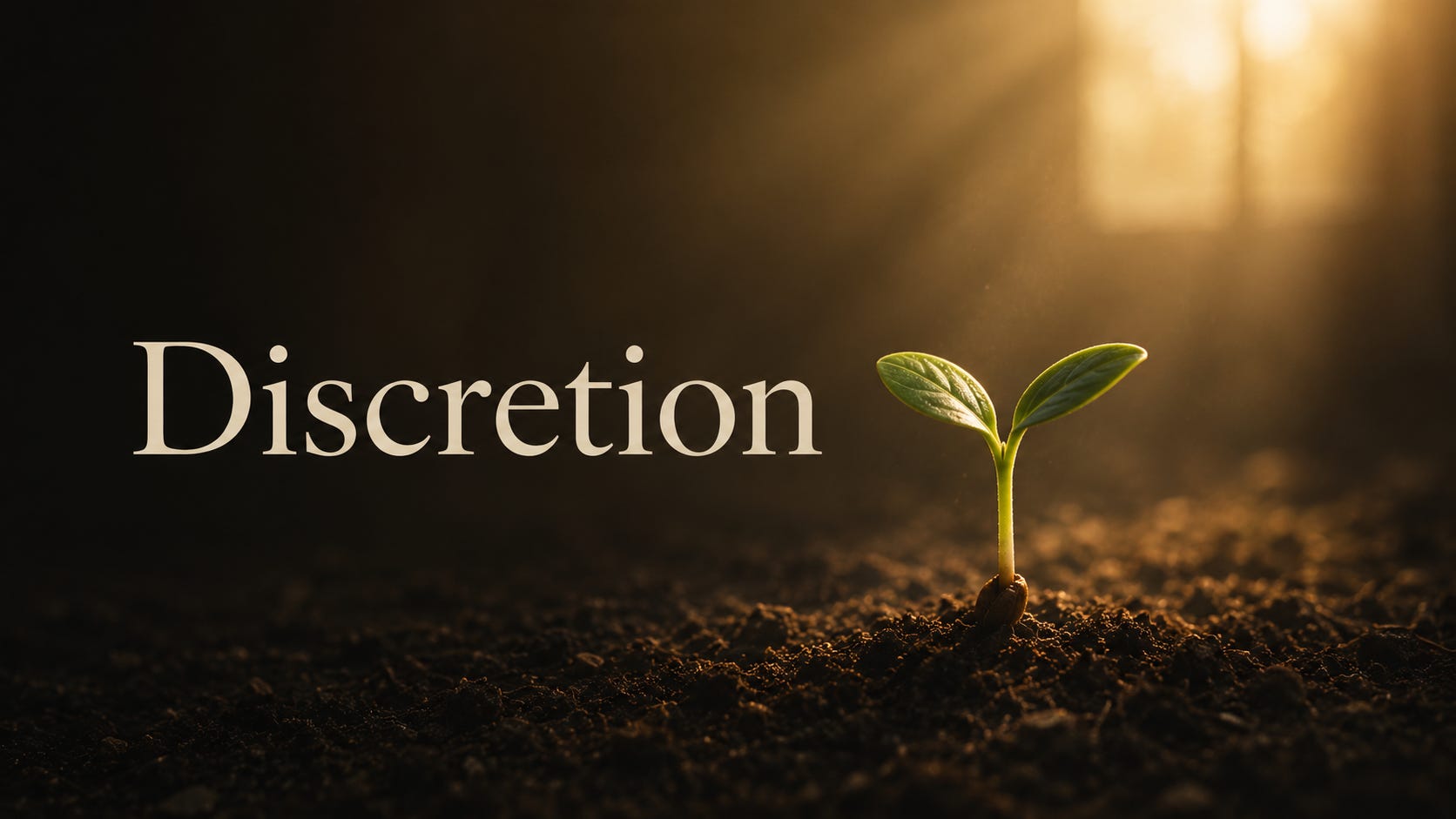
Some of the most significant things God plants in us are meant to grow in the dark for a while. There are things that must be cultivated quietly, protected by discretion, guarded by discernment, until they’re rooted deeply enough, and surrounded by the right people, to bear the weight of being seen.
I needed discretion. I needed discernment. I needed the maturity to know that not every true thing needs to be said, not every good thing needs to be said yet, and not every person is safe to say it to.
I’m still learning these things but I am learning them as a son now instead of from fear, but from security.
That completely changes how I carry what He gives me, and who I choose to carry it with.
There is now no condemnation for those who are in Christ Jesus. — Romans 8:1
Father, I bring You the moments I shared too soon. Whether it was a dream I laid on a table that wasn’t ready to hold it, the sacred things I handed to hands that couldn’t carry them well. I release the shame I’ve attached to those moments, and I release the people I gave it to as well.
I renounce the orphan impulse that told me I had to prove I belonged, that my worth was tied to being known, understood, or affirmed in that moment. I receive instead what has always been true: I am a son. I am a daughter. My place was never earned by what I revealed, and it is not lost by what I revealed too soon.
I ask You to regrow what was exposed before its season. Where exposure has left me feeling small, restore the weight and wonder of what You gave me. Where regret has lingered, turn it into wisdom rather than shame.
Teach me discretion. I want to know Your times and seasons that are always right. Teach me discernment to know the right people. I rest in the security of knowing I belong to You.
What You are forming in me is still real, still Yours, and still growing, whether or not it was ever meant to be seen yet. I trust You with what’s tender in me now. Amen.