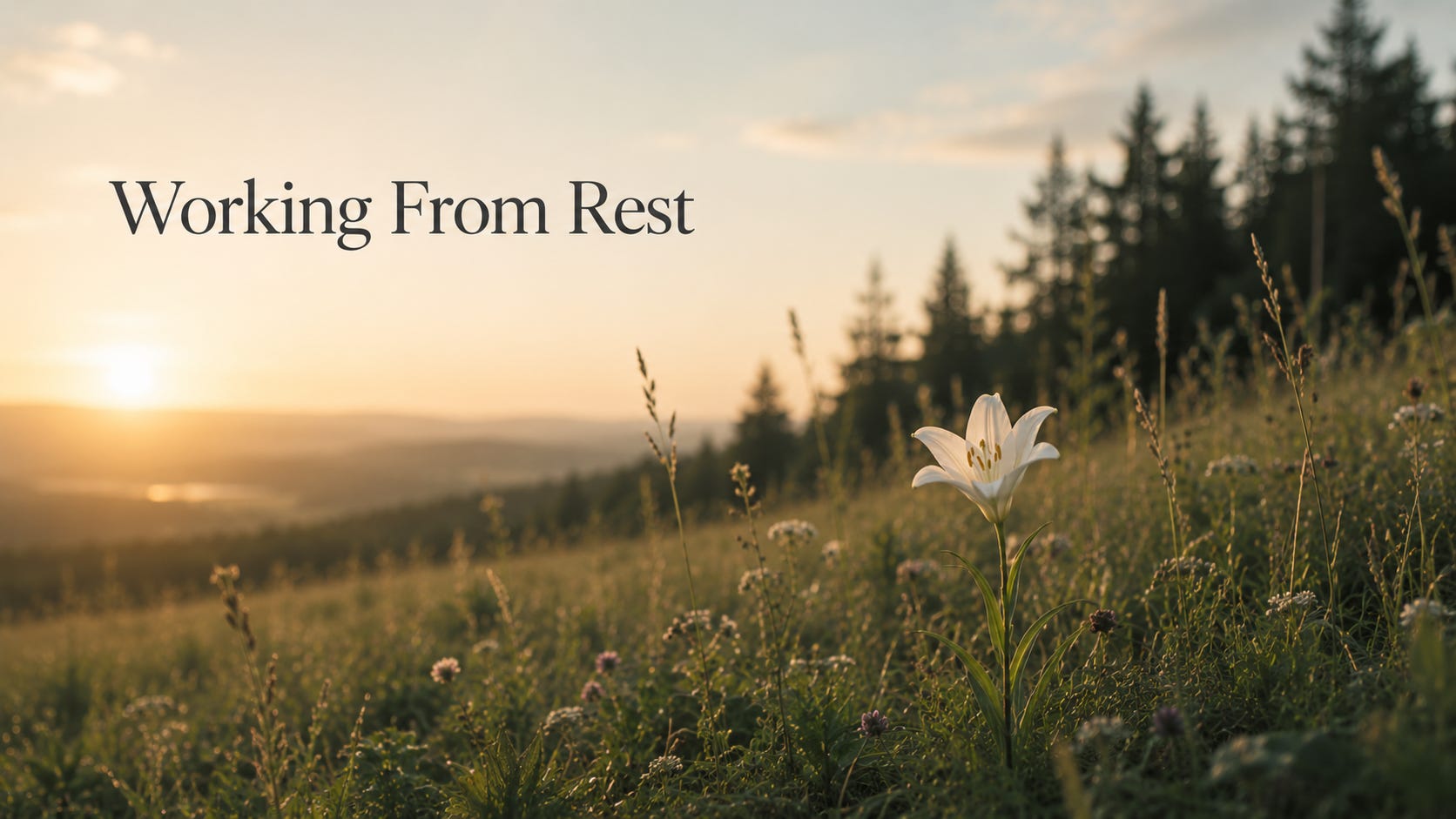
I’m writing this on vacation. Which feels like the right place to write it from, because I’ve been thinking about what it actually looks like to be productive from a place of rest, rather than to rest as a reward for being productive?
Most of us have that backwards. We labour, and then we recover. We strive, and then, if there’s anything left, we rest. But Scripture describes something different , an order that runs the opposite direction.
“There remains therefore a rest for the people of God. For he who has entered His rest has himself also ceased from his works as God did from His.” (Hebrews 4:9-10)
This isn’t simply talking about a day off. The writer of Hebrews is pointing us toward a deeper Sabbath rest fulfilled in the finished work of Jesus. This rest is for more than merely a twenty-four-hour pause in a weekly cycle, but a rest we are invited to enter and live from because of what He has completed.
That word “finished” matters. “It is finished” (John 19:30) not “it is beginning” or “now go and finish it yourself.” Finished. Complete. And because it’s complete, we’re invited to cease from our own works the way God ceased from His, not out of exhaustion, but out of completion.
Jesus made this staggeringly practical in Matthew 6.
“Consider the lilies of the field, how they grow: they neither toil nor spin; and yet I say to you that even Solomon in all his glory was not arrayed like one of these.” (Matthew 6:28-29)
They neither toil nor spin. The lily doesn’t strive for its own beauty. It doesn’t labour to produce its own colour or shape. It simply grows where it’s planted, and the Father clothes it with a splendour that outshines a king’s finest robes.
“If God so clothes the grass of the field… will He not much more clothe you, O you of little faith?” (Matthew 6:30)
If God is that attentive to a flower that lives one season and is gone, how much more attentive is He to you, the one He calls son, daughter, His own?
In the garden, after the fall, God said to Adam: “Cursed is the ground for your sake; in toil you shall eat of it all the days of your life.” (Genesis 3:17) Toil now marks the human experience of sweat, strain, and the exhausting attempt to produce from ground that resists us.
There’s a fascinating connection in the language of the New Testament here. When Jesus taught us to pray, “deliver us from evil,” the Greek word translated evil is ponēros and it is the same word Paul uses when he writes that we should redeem the time “because the days are evil” (Ephesians 5:16). The word carries the sense of what is harmful and afflictive, and its word family carries associations with painful labour and toil. I don’t want to build an entire theology on an etymology, but the connection is interesting and worth taking a look at.
The world after Eden is marked by toil, strain, painful labour, and the constant pressure to produce, secure, and sustain life by the sweat of our own brow. And Jesus comes announcing another way.
“Come to Me, all you who labor and are heavy laden, and I will give you rest.” (Matthew 11:28)
There it is. The writer of Hebrews points us toward a Sabbath rest fulfilled in the finished work of Christ, and Jesus stands before the weary and burdened with an invitation: come to Me. Maybe part of learning to walk in the freedom Jesus purchased is recognizing how easily we return to the old atmosphere of toil and trying to produce through anxiety what the Father intends to grow through abiding. Toil belongs to the old order. Rest is the invitation of the new.
This is the same rest David describes in Psalm 23.
“The LORD is my shepherd; I shall not want. He makes me to lie down in green pastures; He leads me beside the still waters.” (Psalm 23:1-2)
He makes me lie down, not “I forced myself to eventually stop.” The Shepherd leads His sheep to rest. A sheep at rest, secure in the care of a good shepherd, isn’t anxious about tomorrow’s provision. It isn’t striving to secure its own pasture. It’s simply following, trusting, and being led beside still water.
That’s the picture. Not passivity, but security. Not laziness, but trust so complete that striving becomes unnecessary.
The irony isn’t lost on me that I’m writing an article about rest while I’m on vacation. Even here, I’ve caught myself thinking about what I could work on next, what I could write, what I could build. Give me a little quiet alone time and, before long, I’ve turned it into a strategy session. My wife will tell you lol.
I love to create, and I don’t think that’s the problem, we were made to create. But I’m learning there’s a difference between creation and toil. Creation flows. Toil grasps. One responds to what the Father is already breathing into you. The other tries to force something into existence because you’re afraid of what happens if you stop.
Rest can quickly become uncomfortable for those of us wired to produce. The moment things go still, there’s a pull to make something happen to do produce an outcome, to justify the rest by turning it into another form of labour. That pull is old. It’s the same lie from the garden, reach out and do something, take control, produce your own provision, just wearing more sophisticated clothes. It looks productive. It even looks spiritual. But if it’s coming from anxiety rather than peace, from a need to prove something rather than a response to something the Father is already doing, it’s toil dressed up as diligence.
The wise builder in Psalm 127 is warned about exactly this: “Unless the LORD builds the house, they labor in vain who build it… It is vain for you to rise up early, to sit up late, to eat the bread of sorrows; for so He gives His beloved sleep.” (Psalm 127:1-2)
He gives His beloved sleep, not because sleep is more important than work, but because there’s a kind of building that only happens when we stop trying to build it ourselves.
So what does this look like in a normal week? In a vacation? In a season of ministry or business or parenting where there’s genuinely much to do?
It looks like working from a place of total acceptance rather than working to earn it. It looks like creating from love and peace rather than from anxiety about outcomes. It looks like asking, before I move: is this striving, or is this simply walking in step with what He’s already doing?
The lily doesn’t toil, and it’s still clothed in glory. The sheep doesn’t strive, and it still wants for nothing. The house still gets built but the Builder does the heavy lifting, and those He loves get to sleep.
That’s the rest Jesus purchased. Not an escape from productivity, but an entirely different root system underneath it, one where the fruit comes from abiding, not from anxious labour. One where you can be fully engaged with your life and still, underneath it all, be at rest.
I’m on vacation as I write this. And I’m learning, in real time, what it means to let this be true not just for the spa, but for everything I come home to.
Maybe rest was never meant to be the reward waiting for me when the work is finished. Maybe, in Christ, it’s where the work was always meant to begin.